
GWO Basic Safety Training (BST) Explained | Wind Turbine Safety Training | OGTA
The global wind energy industry is expanding rapidly, creating growing demand for technicians who can work safely and competently in wind turbine environments. However, working on wind turbines involves specific hazards, including working at height, fire, manual handling, electrical risks and limited access to emergency assistance. GWO Basic Safety Training, commonly known as GWO BST, […]
The global wind energy industry is expanding rapidly, creating growing demand for technicians who can work safely and competently in wind turbine environments. However, working on wind turbines involves specific hazards, including working at height, fire, manual handling, electrical risks and limited access to emergency assistance.
GWO Basic Safety Training, commonly known as GWO BST, provides essential safety knowledge and practical skills for people working in the wind energy sector.
Oxford Global Training Academy (OGTA) provides GWO Basic Safety Training designed to prepare wind industry personnel for real working conditions. Our training combines theoretical learning with practical exercises conducted under the supervision of qualified instructors.
What Is GWO Basic Safety Training?
GWO stands for Global Wind Organisation, a non-profit organisation established by leading wind turbine manufacturers and wind energy companies.
The purpose of GWO training standards is to create consistent safety and technical training across the global renewable energy industry. Instead of workers completing completely different training for every employer or country, GWO training provides a recognised framework that can be verified by participating employers.
GWO Basic Safety Training introduces participants to the main hazards they may encounter while working in or around wind turbine generators.
- Identify common wind-industry hazards
- Prevent workplace accidents and injuries
- Respond appropriately during emergencies
- Work safely at height
- Use personal protective equipment correctly
- Perform safe manual-handling activities
- Provide immediate first aid
- Respond to fire-related emergencies
The programme places strong emphasis on practical participation because workers must be capable of applying safety procedures in real situations.
Who Should Attend GWO BST?
GWO Basic Safety Training is suitable for people who work or plan to work in the wind energy industry.
Typical participants include:
- Wind turbine technicians
- Wind turbine installation personnel
- Operations and maintenance teams
- Mechanical and electrical technicians
- Commissioning personnel
- Service technicians
- Site supervisors
- Contractors working at wind farms
- HSE and safety professionals
- New entrants seeking careers in wind energy
- Employees who require GWO refresher training
Employers or site operators may require additional technical qualifications, medical fitness assessments or job-specific training depending on the participant’s role and work location.
GWO Basic Safety Training Modules
The GWO BST programme is divided into individual safety modules. Each module addresses a major area of risk within the wind industry.
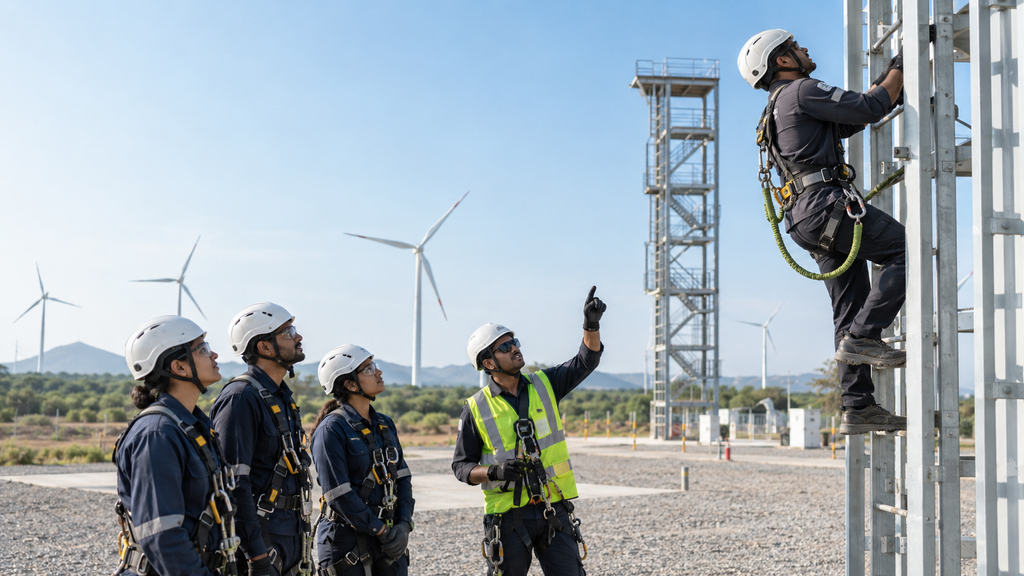
GWO Working at Heights
Working at height is one of the most significant hazards faced by wind turbine technicians. Personnel may need to climb towers, enter nacelles, access ladders and work in locations where a fall could cause serious injury or death.
The Working at Heights module helps participants understand how to prevent falls and respond to height-related emergencies.
The training generally covers:
- Hazards associated with working at height
- Correct selection and inspection of personal protective equipment
- Use of harnesses, helmets, lanyards and fall-arrest systems
- Safe ladder-climbing practices
- Anchor points and attachment methods
- Prevention of dropped objects
- Suspension-related risks
- Basic rescue and evacuation principles
- Practical rescue exercises
Participants complete practical activities using appropriate equipment in a controlled training environment. The objective is to help them perform work-at-height activities safely and respond correctly if an emergency occurs.
GWO First Aid
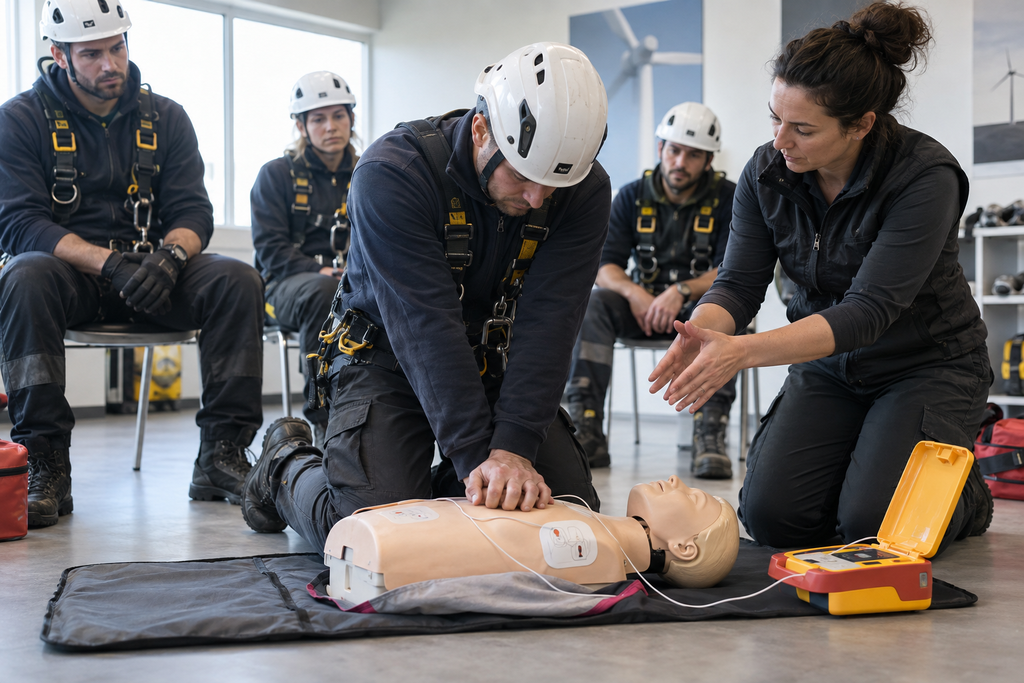
Wind turbines may be located in remote areas where professional medical assistance cannot arrive immediately. Workers must therefore be prepared to recognise serious conditions and provide immediate assistance until qualified medical help becomes available.
The First Aid module develops essential emergency-response capabilities relevant to wind turbine environments.
Topics generally include:
- Primary assessment of an injured person
- Identifying life-threatening conditions
- Cardiopulmonary resuscitation
- Use of an automated external defibrillator
- Managing bleeding and shock
- Treatment of minor and serious injuries
- Positioning and monitoring a casualty
- Communicating with emergency services
- First-aid scenarios related to wind turbine work
Participants practise responding to simulated incidents so that they can make appropriate decisions during an actual emergency.
GWO Fire Awareness
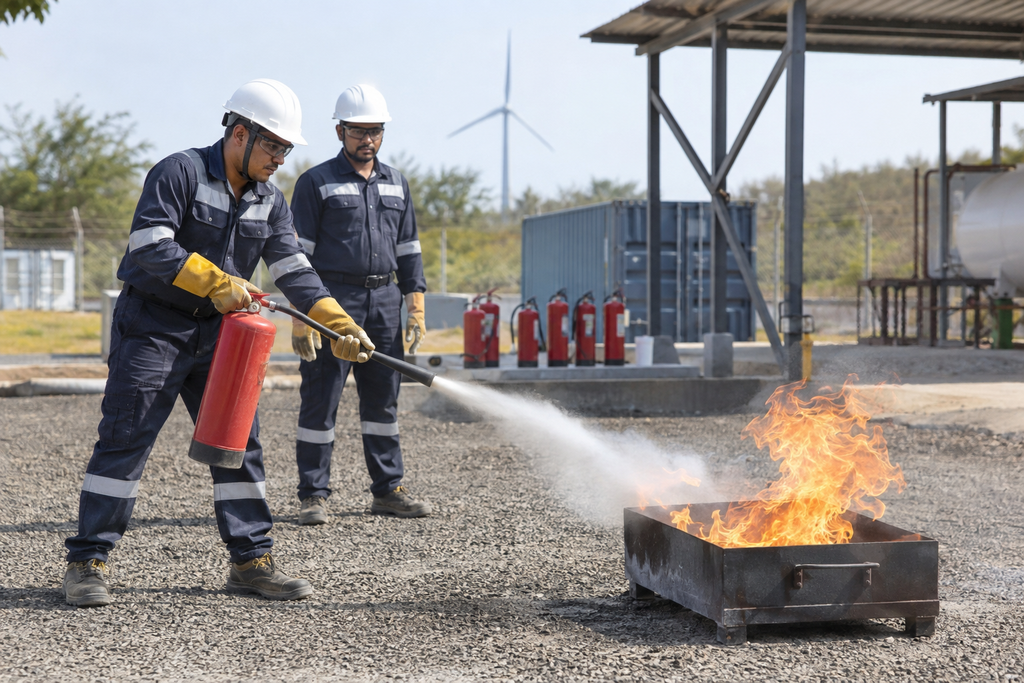
Wind turbines contain electrical equipment, mechanical components, lubricants and other materials that can contribute to fire risk. Limited escape routes and the height of the structure can make a turbine fire particularly dangerous.
The Fire Awareness module teaches participants how to prevent fires, assess a developing incident and respond safely.
The training generally includes:
- The fire triangle
- Common causes of fire in wind turbines
- Fire prevention measures
- Fire detection and alarm procedures
- Emergency evacuation
- Different classes of fire
- Selection of suitable fire extinguishers
- Safe use of basic firefighting equipment
- Practical fire-extinguishing exercises
The priority is always personal safety. Participants learn how to determine whether an initial fire can be managed safely and when immediate evacuation is required.
GWO Manual Handling
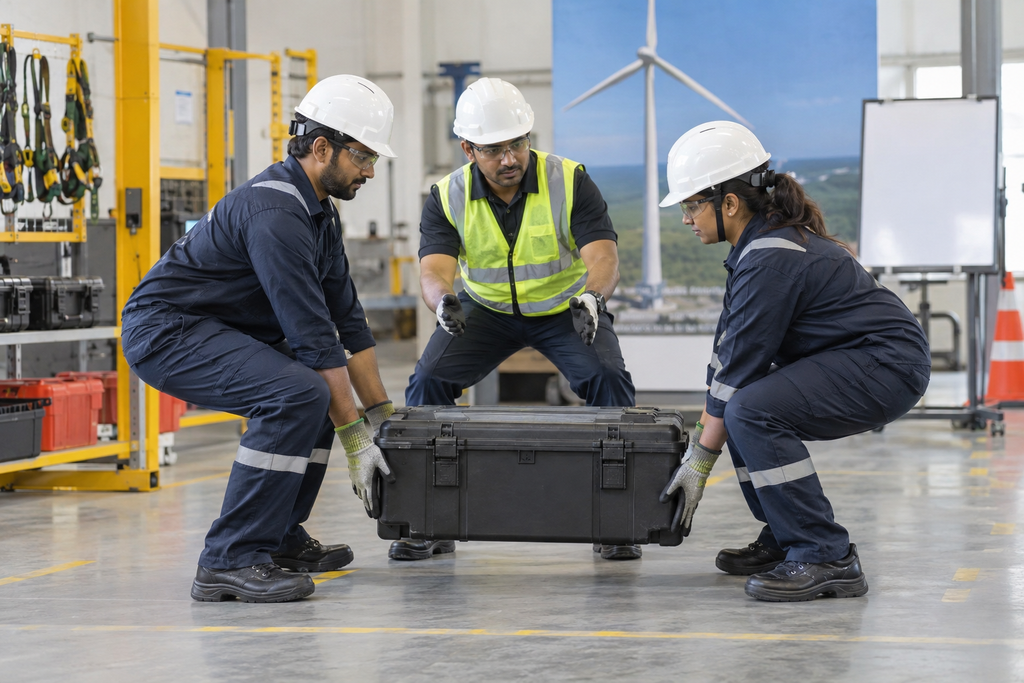
Wind turbine technicians may lift tools, carry equipment, move components and work in restricted spaces. Incorrect manual-handling techniques can lead to back injuries, strains and other musculoskeletal disorders.
The Manual Handling module helps participants understand how to perform physical tasks with reduced risk of injury.
The module generally covers:
- Common causes of manual-handling injuries
- Basic principles of body movement
- Evaluating a manual-handling task
- Safe lifting and carrying techniques
- Team lifting
- Use of mechanical assistance
- Working in restricted positions
- Planning tasks before moving a load
- Practical manual-handling exercises
Participants learn that manual handling is not simply about lifting correctly. Effective risk reduction also involves planning the task, reducing the load, improving the working environment and using suitable equipment whenever possible.
Is Sea Survival Included in GWO BST?
Sea Survival is particularly relevant to personnel travelling to or working at offshore wind farms.
This module addresses hazards associated with offshore transfers and emergency situations at sea. It may cover survival equipment, marine transfer, man-overboard situations, emergency procedures and practical survival exercises.
Personnel working only at onshore wind farms may not require Sea Survival. The modules required for each participant should be determined according to the employer, project, location and job responsibilities.
What Is WINDA?
WINDA is the GWO industry database used to maintain and verify training records.
Participants normally need a WINDA profile and WINDA ID so that a certified training provider can upload their completed training records. Employers can then verify the individual’s current GWO training status through the system.
Participants should ensure that their name and personal details are entered correctly when registering. They should provide their WINDA ID to the training provider before or during registration.
How Long Is GWO BST Valid?
GWO training records normally have a defined validity period. Participants must complete the appropriate refresher training before their current records expire if they need to maintain continuous validity.
Candidates should not wait until the final day to arrange refresher training. Course availability, travel arrangements and employer requirements can cause delays.
Always confirm the applicable validity and refresher requirements using the participant’s WINDA record and the latest GWO requirements.
Benefits of GWO Basic Safety Training
Completing GWO BST can provide several important benefits:
- Development of essential wind-industry safety skills
- Improved awareness of workplace hazards
- Practical experience with emergency procedures
- Verifiable training records through WINDA
- Better preparation for wind-energy employment
- Increased confidence when working in challenging environments
- Consistent safety knowledge across different projects
- Reduced need to repeat equivalent basic training
GWO training supports safety competence, but it does not automatically guarantee employment or replace employer-specific training, site induction, medical requirements or technical qualifications.
Why Choose OGTA for GWO Training?
Oxford Global Training Academy is committed to delivering practical and professional safety training for the wind energy industry.
Participants choosing OGTA can benefit from:
- GWO-accredited training delivery
- Qualified and experienced instructors
- Practical, activity-based learning
- Training equipment relevant to course requirements
- Guidance regarding WINDA registration
- A strong focus on participant safety
- Convenient training support in India
- A professional learning environment
OGTA’s GWO WINDA Training Provider ID is TPU01782IN.
Our objective is not only to help participants complete their training but also to ensure that they understand how to apply the learning in real wind-industry workplaces.
Preparing for GWO BST at OGTA
Before attending the course, participants should:
- Create or confirm their WINDA profile
- Share their correct WINDA ID
- Confirm that they meet applicable medical and fitness requirements
- Bring valid identification
- Wear suitable clothing for practical activities
- Follow all instructions provided by the training centre
- Inform the training provider about any medical condition or limitation that may affect participation
GWO BST includes physical and practical activities. Participants should contact OGTA before booking if they have any concerns about their ability to participate safely.
Frequently Asked Questions
What does GWO BST mean?
GWO BST means Global Wind Organisation Basic Safety Training. It develops basic safety and emergency-response skills for personnel working in the wind energy industry.
Is GWO BST required for wind turbine jobs?
Many wind-industry employers and projects require relevant GWO training. Exact requirements depend on the job, employer, project and whether the work is onshore or offshore.
Can someone without wind-industry experience attend?
New entrants may attend if they meet the training provider’s eligibility, identification, health and safety requirements. Additional technical education or experience may still be required for employment.
Are the training records available online?
After successful completion and upload by the training provider, the participant’s training records can be accessed and verified through WINDA.
Does GWO BST guarantee employment?
No. The training demonstrates completion of specified safety modules, but employment decisions depend on technical qualifications, experience, medical fitness and the employer’s requirements.
Where can I attend GWO BST in India?
Oxford Global Training Academy provides GWO Basic Safety Training in India. Contact OGTA to confirm course dates, available modules, fees and registration requirements.
Start Your Wind-Energy Safety Training with OGTA
Safety training is essential for anyone planning to work in the demanding environment of wind turbine installation, operation or maintenance.
GWO Basic Safety Training equips participants with essential knowledge and practical capabilities in Working at Heights, First Aid, Fire Awareness and Manual Handling. Offshore personnel may also require Sea Survival training depending on their responsibilities.
To learn more about upcoming GWO training programmes, course availability and registration, contact Oxford Global Training Academy.
Website: www.ogta.in
Email: admin@ogta.in
GWO WINDA Training Provider ID: TPU01782IN
NEED GWO TRAINING?